Voices
Forum front page //// Events //// site index
The Discovering Autonomy Conference – London 21st July 2005
“Leave the
word 'impossible' in the dictionary”
An Intriguing Report on National Voices Forum's one day conference
held in The Resource Centre, Holloway Road, LONDON
More than sixty members of
National Voices Forum from all over the United Kingdom gathered
in Central London for the one day Discovering Autonomy conference.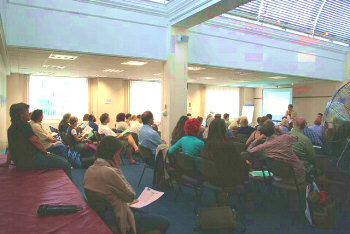 At the plenary session, they heard
speakers Rachel Perkins, Chris Barchard and Jan Wallcraft and
participated in seven workshops which offered topics based around
achieving service users' autonomy and empowerment.. Delegates
could chose from workshop themes such as self-management,
creativity, ethnicity, strategies for living and complementary
therapies. The conference was chaired by National Voices Forums'
Vice Chair Clare Crestani who carried out her role with a great
deal of style and humour. Some delegates were of the opinion that
because of the recent terrorist incident in London, a number of
people had been put off attending the conference so delegates
were not as numerous as expected. Indeed the day was overshadowed
by more terrorist incidents in Central London and although the
conference continued unhindered, many delegates found they had a
difficult journey getting home because of the disruption to
transport.
At the plenary session, they heard
speakers Rachel Perkins, Chris Barchard and Jan Wallcraft and
participated in seven workshops which offered topics based around
achieving service users' autonomy and empowerment.. Delegates
could chose from workshop themes such as self-management,
creativity, ethnicity, strategies for living and complementary
therapies. The conference was chaired by National Voices Forums'
Vice Chair Clare Crestani who carried out her role with a great
deal of style and humour. Some delegates were of the opinion that
because of the recent terrorist incident in London, a number of
people had been put off attending the conference so delegates
were not as numerous as expected. Indeed the day was overshadowed
by more terrorist incidents in Central London and although the
conference continued unhindered, many delegates found they had a
difficult journey getting home because of the disruption to
transport.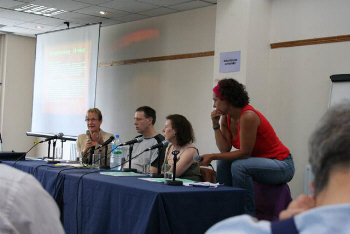 However, every one who took part agreed
that it was an entertaining, informative and worthwhile day and
their thanks went to Amy Ford and Rachel Brett of National
Voices Forum for organising and managing a really successful
event. Many expressed the hope that in future National Voices
Forum can organise a conference to run for more than one day.
However, every one who took part agreed
that it was an entertaining, informative and worthwhile day and
their thanks went to Amy Ford and Rachel Brett of National
Voices Forum for organising and managing a really successful
event. Many expressed the hope that in future National Voices
Forum can organise a conference to run for more than one day.
Delegates felt that the
conference had promoted friendship, self-help and autonomy and
the realisation that everyone had something to offer: Empowerment
and recovery could be within everyone's reach: leave the word
“impossible” in the dictionary!
Discovering
Autonomy – Plenary Session
1. Rachel
Perkins, Clinical Director and Consultant Clinical Psychologist
of South West London and St George's Mental Health Trust:
“Living
Life to the Full – A Personal Recovery Journey”.
Rachel opened by talking about
her background in terms of career and experience as a service
user (Rachel is diagnosed with manic depression). In her career
as head of a mental health trust she is also her psychiatrist's
boss. She talked of the paradox whereby she can have a successful
career as head of a trust but how because of her mental health
she cannot sit on a jury and gets asked awkward questions about
mental health when entering the United States with the green form. She discussed how the media represent
mental health service users in terms of stereotypes: they are
either “poor unfortunates” who can't help themselves or
“mad axe murderers” that the public need to be
protected from. She said that often worse than the illness itself
is the prejudice, ignorance and fear that attends public opinion
of mental health service users: this is almost more disabling
than the symptoms. Unlike a criminal record that can be spent
– your mental illness always follows your record around and
always creates stigma when applying for jobs, when seeking health
treatment and when dealing with authorities such as the police.
People are dismissive of mental health service users and there is
subtle discrimination, prejudice and exclusion. No matter what
service users achieve they are always judged by their illness.
She discussed how the media represent
mental health service users in terms of stereotypes: they are
either “poor unfortunates” who can't help themselves or
“mad axe murderers” that the public need to be
protected from. She said that often worse than the illness itself
is the prejudice, ignorance and fear that attends public opinion
of mental health service users: this is almost more disabling
than the symptoms. Unlike a criminal record that can be spent
– your mental illness always follows your record around and
always creates stigma when applying for jobs, when seeking health
treatment and when dealing with authorities such as the police.
People are dismissive of mental health service users and there is
subtle discrimination, prejudice and exclusion. No matter what
service users achieve they are always judged by their illness.
Recovery is possible and service
users can achieve a meaningful, valued and satisfying life –
although recovery is not about “cure”. Service users
are the experts on mental health and they should be the people
shaping treatment and research. Rachel referred to famous
historic figures such as Winston Churchill, Einstein, Babbage,
and Ravel who all had mental health problems and although in her
personal experience her problems do not go away, she is fortunate
in being able to manage them. Service users must have hope and
opportunity – these are important to rebuilding life after
mental illness. When being treated for her illness, Rachel was
advised to retire from work: however she persevered and went on
to achieving the publication of three books, the writing of
numerous articles and gaining three job promotions. However for
many service users is it difficult to sustain hope without
opportunity and support. Being able to participate and contribute
in society is a key element to recovery : for many service users
their mental illness presents a challenge but this is not in
surmountable. There are images of possibility and service users
should have a decent future as - they all have valuable things to
contribute to society. Rachel concluded by saying that together
we can all cure prejudice, ignorance and fear and she told her
audience: “Keep chasing your dreams”.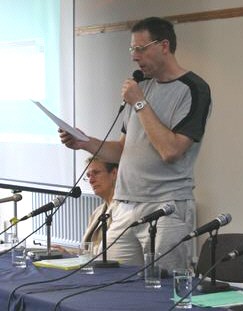
2. Chris
Barchard, Chair of National Voices Forum:
“Is
there a limit to Empowerment?”.
Chris said that returning to
being how you once were before your mental illness is achieving
recovery – but access to opportunity is difficult as stigma
and discrimination is deep. Service users are used to facing the
dilemma of taking drugs which disempower because of side effects
in order to alleviate the symptoms of mental illness. Psychiatry
and treatment are disempowering – it feels like swimming in
glue. Empowerment is re-empowerment.
Chris went on to define 5
elements of empowerment: material, medical, social, work and
personal self worth. Empowerment means having choice and
recreating your sense of self worth. In terms of treatment for
mental illness the service user should work in equal partnership
with the psychiatrist and not be disabled by medication. New
medications make for more possibilities to lead a full life
however standards of life in terms of the service user's
accommodation and benefits should also be improved. Social
empowerment and empowerment through work and personal self worth
are more difficult to achieve because of stigma and
discrimination – the service user is constantly trying to
reach beyond the mental health system and into the mainstream of
society.
Although the government means
well by their policy and programme of social inclusion there are
misgiving and difficulties about this push to change stigma. Also
on the one hand the government aims to change stigma but on the
other creates it by the proposed new Mental Health Act. Social
inclusion can also mean pushing vulnerable people into work in
order to save on the incapacity benefit expenditure – this
is a harmful exercise in social control. Work may be a good idea
but it is not for everyone. It was not empowering to be pushed
into work and be threatened with loss of social security benefits
– the government should offer support in helping people who
want to return to work rather than coercing them into doing so.
Although Chris did not advise
service users to abandon taking their medication without talking
to their doctor, he pointed out that some people affected by
mental illness benefited for alternative treatments such as
herbal remedies and other therapies – these worked well for
some. There also beneficial therapies offered by music, massage,
art, social relationships and also talking therapies –
although talking therapies were sometimes difficult and painful.
However such therapies outside standard medications help people
to take control of their lives. Service users could decide on
their own treatment and take control.
Empowerment does not come
through accessing conventional mental health services but with
how far service users can get away from them. Medical
professional can disempower patients and they should believe more
in who they are treating.
Although the mental asylums are
now closed the majority of society had still to include mental
health patients. Treatment is more than just taking drugs –
it is social as well as medical. There are still social obstacles
to empowerment. However ultimately empowerment is a very
individual thing: grasp for it and use it your way.
3. Jan
Wallcraft, Fellow, Experts by Experience, London Development
Centre, NIMHE.
“From
Surviving to Thriving”.
Rather than recovery from mental
illness there is also recovery from stigma, trauma, abuse and
crushed dreams. It is important for service users to share their
stories and experiences with each other both in hospital and
outside hospital in order to gain strength from shared experience.
Jan questioned the caused of mental illness: 80% of cases were
related to some form of trauma, although some mental illnesses
come out of the blue and are not related to trauma and abuse.
Some treatments such as ECT can make patients worse.
Telling their story is
therapeutic for service users and narrative research where
stories are collected is important although at present there is
very little of this type of research in mental health. Everybody's story of breakdown is
different. Can telling your story help with recovery? It does
have a liberating effect as by sharing stories of trauma service
users find that they are not alone. Relating stories can have a
powerful healing effect and also help society to understand
mental trauma and break down the taboos, fears and anxieties
surrounding mental illness.
Everybody's story of breakdown is
different. Can telling your story help with recovery? It does
have a liberating effect as by sharing stories of trauma service
users find that they are not alone. Relating stories can have a
powerful healing effect and also help society to understand
mental trauma and break down the taboos, fears and anxieties
surrounding mental illness.
Jan went on to ask whether
mental health services promote or hinder recovery. Recovery means
taking control and self responsibility and services should
support service users' own coping strategies rather than make
them dependant on psychiatry and drug treatment. Psychiatry is
only a small part of people's lives. Service users should go
beyond being survivors and go on to being healed and thriving.
“Survivor” is not the only badge. Put an end to your
bad times: put them behind you and thrive as a free creature.
The full content of Chris
Barchard's talk 'Is there a limit to Empowerment' from the day is Chris Barchard's page.